A Calm Index for Shared Habits
Browse practical notes for everyday food routines
Index: What You'll Find Here
This collection offers practical guidance on everyday eating routines, built on shared understanding between you and your nutrition guide. Each card explores a different aspect of sustainable habits.
The Process: How We Work Together
A five-step framework showing the shared journey of clarifying goals, observing patterns, making adjustments, offering support, and reflecting on progress.
Practice Card: Everyday UK Scenes
Real-world moments—from packing lunch to choosing in a supermarket—showing how calm food choices fit into daily life.
Packed-Lunch Logic (Without Perfection)
Practical tips for preparing meals that nourish you and fit your routine, without pressure for flawlessness.
Social Food, Calm Choices
Navigating meals with others—friends, family, colleagues—while staying grounded in your own values and needs.
Reflection & Adjustment
Questions to help you notice patterns, understand what works, and make steady improvements over time.
The Process Card: How We Work Together
Nutrition guidance is a shared process. It's not about rules handed down or quick fixes. It's about dialogue, observation, and steady progress. Here's how we work together:
Understand your goals, preferences, and what matters to you.
Notice your current patterns, rhythms, and how food fits into your life.
Make gentle, sustainable changes based on what you've learned.
Receive guidance and accountability from your nutrition partner.
Reflect on progress and adjust your approach as needed.
This is not a linear journey. You may move between these steps many times, and that's natural and healthy.
Practice Card: Everyday UK Scenes
Calm food choices happen in real moments, in ordinary places. Here are five everyday scenes showing how sustainable habits fit into daily life:
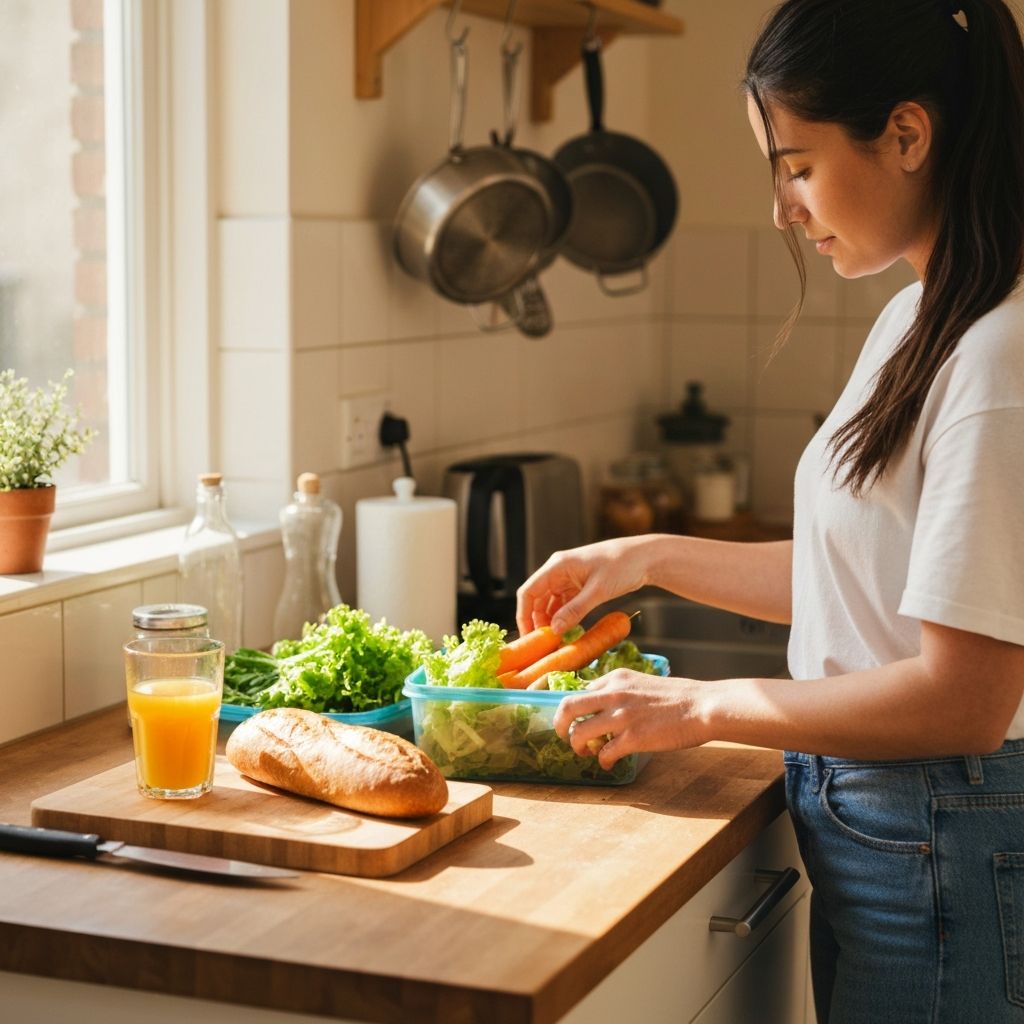
Packing a Lunch at Home
A quiet morning moment. You're choosing what goes into your lunch box—vegetables, protein, something you'll enjoy. Not thinking about "clean eating" or rules, just what will nourish you through your day.
Writing a Shopping List
Before heading out, you've thought about what you need. A list helps you stay calm and intentional in the supermarket. You're planning, not rushing. You know roughly what meals you want and what ingredients support that.


Choosing in the Supermarket
You're reading labels. You're noticing what's in stock. You might spot something new, or you might choose what you always do. There's no "good" or "bad" aisle—just choices that fit your life.
A Relaxed Café Lunch
You're sitting with a tea or coffee, enjoying your meal without hurry. Maybe you're with a friend. You're tasting your food, noticing what you enjoy. This is nourishment, not just fuel.


A Walk After Work
You've eaten, and now you're moving gently through the world. A walk isn't exercise to "earn" your food—it's part of a calm routine that helps you feel grounded and present.
Packed-Lunch Logic (Without Perfection)
Preparing your own lunch is one of the most practical ways to support steady eating habits. It's not about elaborate meal prep or Instagram-worthy boxes—it's about showing up for yourself.
Why Pack Your Own Lunch?
- You know what's in it. No hidden ingredients, no surprises. You choose the portions and the balance.
- It supports your routine. A predictable lunch helps you feel grounded and less vulnerable to decision fatigue later.
- It's practical. You can eat on your schedule, in a place where you feel comfortable. No rushing, no pressure.
- It's an act of care. Taking time to prepare food for yourself is a way of saying, "My wellbeing matters."
Simple Principles
Keep it repeatable. Find 2–3 combinations you genuinely enjoy, and rotate them. Boring is good—it means you're not overthinking.
Aim for balance. A bit of protein, vegetables, whole grains, and something satisfying. Not rigid ratios—just a simple shape to your lunch.
Make room for variety. Within those repeatable combinations, you can swap proteins, add different vegetables, or choose a different grain. Small changes keep it interesting without complication.
Forget perfection. Some days you'll pack something elaborate. Other days it'll be simple. Both are fine. The habit is the point, not the Pinterest aesthetic.
Social Food, Calm Choices
Food is social. Meals with friends, family meals, workplace lunches—these are essential parts of life. Calm food choices don't mean opting out of these moments. They mean showing up in a way that feels true to you.
At the Table
You don't need to announce your approach to food or justify your choices. You can eat what feels right for you, without comment. If someone asks, you can share briefly and gently. If they don't, you don't owe an explanation.
When Food Is Uncertain
You're invited out and unsure what will be available. That's normal. You might ask gently what will be served, so you can plan. You might bring a dish to share. You might eat beforehand and join for tea. There's no "wrong" way to handle it—just what works for you.
Managing Pressure
Sometimes people comment on what or how much you eat. You can listen without engaging. You can say, "This works for me" and move on. You're not responsible for explaining or defending your choices to anyone. Calm food choices are a conversation between you and your nutrition guide, not something to debate at the dinner table.
Roles Card + About Us
What You Bring
- Your lived experience and daily reality
- Honest observation of your patterns
- Openness to gentle change
- Willingness to try, reflect, and adjust
- Trust in the process
- Your preferences and what matters to you
What Your Nutrition Guide Brings
- Knowledge of nutrition and how food supports your body
- Experience helping others find sustainable routines
- Practical, realistic suggestions tailored to your life
- Regular check-ins and accountability
- A non-judgmental space to reflect
- Clear explanations without jargon
About Wigwisekj
Wigwisekj is an advisory nutrition blog built on a simple belief: that eating well is not about extreme measures or medical intervention. It's about dialogue, adaptation, steady support, and shared responsibility. This project exists to offer practical guidance for people who want to support their wellbeing through everyday food choices, without promises or pressure. We focus on process over perfection, partnership over prescription, and realistic routines over trends.
Reflection Questions
These questions are designed to help you notice patterns and understand what works for you. You don't need to answer all of them at once. Return to them when you feel ready to reflect.
- When do you feel most grounded and calm around food? What's happening in those moments?
- What's one small change you've noticed making a difference in how you feel day-to-day?
- Where do you feel pressure around food choices, and where does it come from?
- What does sustainable look like for you? Not for anyone else—just for your life, right now.
- What support would help you move forward? What do you need from your nutrition guide or from yourself?
Get in Touch
Have questions or want to learn more? We'd love to hear from you. Use the form below to get in touch.
Important Health Disclaimer
The information presented on this website is for informational purposes only and does not constitute medical advice, diagnosis, treatment, or care. Wigwisekj is an advisory nutrition blog, not a medical service. We do not diagnose conditions, prescribe medications, or provide medical treatment. For medical concerns or health emergencies, please consult a qualified healthcare professional. Nutrition guidance is a shared process of dialogue and adaptation—not a replacement for professional medical care.
Contact Information
Wigwisekj Ltd
28 George Street
Edinburgh EH2 3PF
United Kingdom
Phone: +44 131 769 4285
Email: [email protected]